
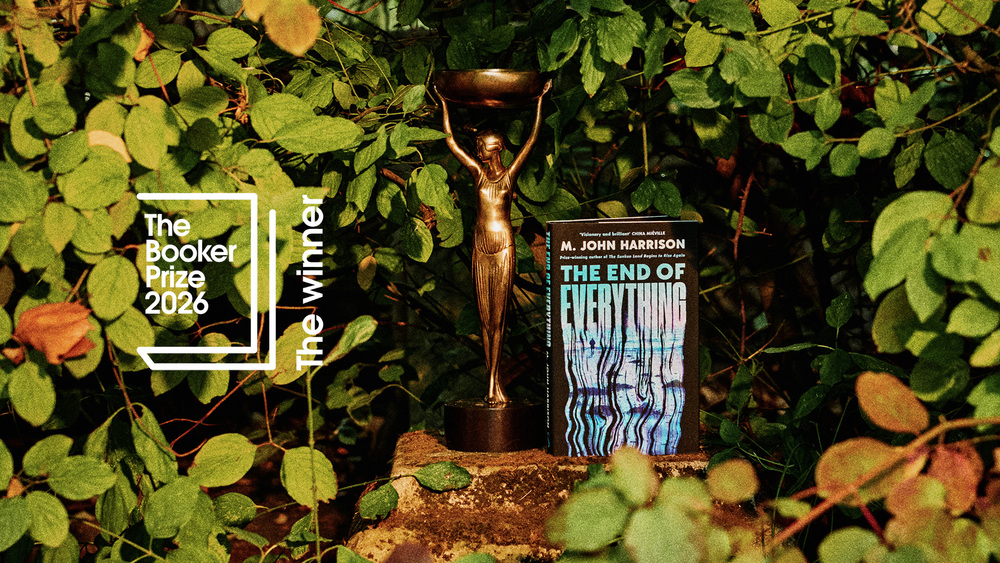
The End of Everything by M. John Harrison has been named the winner of the Booker Prize 2026. Harrison receives £50,000 and a trophy, presented to him by last year’s winner David Szalay, at a ceremony held at Old Billingsgate in London.
The event was broadcast live in a special episode of BBC Radio 4’s Front Row, hosted by Samira Ahmed. It was also livestreamed on the Booker Prizes’ YouTube and Instagram channels, with additional red-carpet coverage posted on the Booker Prizes’ social accounts. Watch the livestream here.
The Booker Prize is the world’s most significant award for a single work of fiction. The prize is open to authors from anywhere in the world, writing in English, and published in the UK and/or Ireland. It has rewarded and celebrated world-class talent for over 55 years, helping shape the canon of 20th and 21st-century English language literature. Previous winners of the prize include Salman Rushdie, J.M. Coetzee, Arundhati Roy, Kazuo Ishiguro, Margaret Atwood, Hilary Mantel, Paul Beatty, Bernardine Evaristo and Samantha Harvey.
The End of Everything was selected as the winner from a shortlist of six books by the 2026 judging panel,
who all attended the ceremony. The panel was chaired by celebrated classicist, writer and broadcaster Mary
Beard, who was joined by award-winning poet, writer and educator Raymond Antrobus; musician, writer
and broadcaster Jarvis Cocker; journalist, editor and critic Rebecca Liu; and Booker Prize-shortlisted novelist, poet and essayist Patricia Lockwood. They considered 163 books and were looking for the best work of long-form fiction by writers of any nationality, written in English and published in the UK and/or Ireland between 1 October 2025 and 30 September 2026.
The End of Everything is a destabilising and satirical dystopian novel that follows a beachcomber and his
pistol-toting aunt as they eke out an existence together on a near-future Kent coast. The narrative is set
against a backdrop of societal collapse and the mysterious invasion of shapeshifting entities called the
iGhetti. A violent act near the start of the novel plunges the characters into a post-moral universe. Like the
fog that intermittently cloaks the vividly rendered landscapes within it, the novel is shrouded in a dream-like ambiguity. Writing in short, filmic chapters, Harrison both leans on conventional literary forms and upends them, probing the limits of human understanding and letting the reader fill in the gaps. At 198 pages, it was the shortest book on the shortlist.
Mary Beard, Booker Prize 2026 Chair of judges, says:
‘The Booker judges spent a whole day debating the six remarkable novels on this year’s shortlist, before agreeing unanimously to award the 2026 prize to The End of Everything by M. John Harrison.
‘It’s a book that turns you upside down, raises a wry smile – and surprisingly, given the subject matter, leaves you with a twinge of optimism. Central to the story are Phillip Tennent and his elderly aunt Marnie, living on the south coast of England, a few decades into the future, some years after a mysterious catastrophe: an invasion of “iGhetti” (the “i” hinting at something digital, but you can’t be sure).
‘Social norms have been eroded, law and order have fallen into the hands of vigilantes, and you may well have a crashed plane lodged in your garden. People try to muddle through nonetheless, even making a show of business as usual (children’s parties and a morning coffee at a seaside café).
‘Some try desperately to make sense of what has happened. But one main point of the book is that if, or when, such an apocalypse comes it will be incomprehensible. And the old rules won’t matter either. Phillip is landed with an “item” he found on the beach, a blob of jelly which quickly grows, develops speech and starts to tell his human minders what to do. This is the politics of now seen through the lens of the future.’
Gaby Wood, Chief Executive of the Booker Prize Foundation, added:
‘Many past Booker Prize authors have borrowed facets of science fiction in their work, but M. John Harrison is the first Booker winner to have emerged from the bona fide SF world. He is a genuinely original thinker, a genre-defying writer who takes ideas seriously.
‘_The End of Everything_ is a novel that knows everything about the novel form, and exactly what it’s doing when it breaks it. Readers will also recognise many tropes from cinema: the disaster movie, the road movie, the couple on the run, the noir heroine with a gun in her bag, the apocalypse.
‘Though very unsettling, The End of Everything is not in fact a strange book. It’s a realist book about a strange world, populated by desperate, unmoored characters. One of the judges memorably described it as owing as much to Katherine Mansfield as it does to J.G. Ballard. Marnie, one of the protagonists, suffers from dementia, and dementia offers a framework for understanding the novel as a whole: everything in this post-disaster world is scrambled.
‘Harrison reports on an imagined post-apocalyptic, Large Language Model-dotted landscape with a
documentary eye. Like his beachcomber character Philip, Harrison is a collector: he has spent a lifetime
gathering words for things most people would not think to name. His sentences are collages of intense
descriptive precision.
‘This is a historic win, for a writer whose decades of work are lightly worn on every page.’
The Booker Prize 2026 campaign is rooted in the idea of our individual reading lives – how our personal histories, interests and locations influence the role that books play in our lives and help us connect with others through great fiction.
Find out more about the winning book.
Explore more:
- ‘Everything you need to know about the winner of the Booker Prize 2026’
- ‘Shortlist films’
- ’Everything you need to know about the shortlist’
- ’What the judges say about the 2026 shortlist’
- ’Shortlist reading guides’
- ’Shortlist extracts’
Get involved
If you work in a library or workplace and would like to promote the shortlist, you can order FREE display packs from our shop.
What do you think of the 2026 winning title? Add your comments below, or click any title above to leave a review.
Share your thoughts with us on Facebook, X and Instagram and tag @thebookerprizes.
Keep up with all the latest news on the Booker Prizes website.
Want to make sure you never miss the latest book club news? Sign up for our free monthly newsletter.


