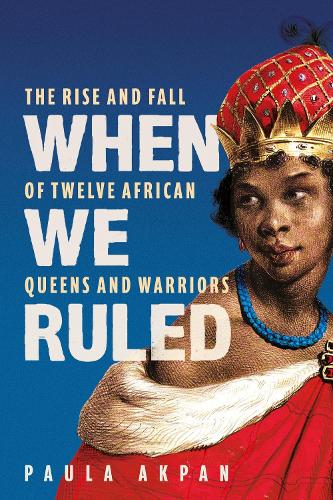
When We Ruled: 'A history the world needs' Bettany Hughes
As seen:
By Paula Akpan
avg rating
2 reviews
‘A searing, nourishing journey through a history the world needs’ – Bettany Hughes, bestselling author of The Seven Wonders of the Ancient World
‘This sweeping history restores women to the centre of African political power…both accessible and rigorous’ The Observer
‘Please read it!’ – Philippa Gregory, bestselling author of Normal Women
‘Poetic and fierce’ – Olivette Otele, author of African Europeans
‘An exciting and rich work for anyone who is curious about African history’ – Paterson Joseph, author of The Secret Diaries of Charles Ignatius Sancho
‘Beautiful and thought-provoking’ – Stylist
There are women who ruled vast swathes of the African continent. They led, loved and fought for their kingdoms and people and their impact can still be felt today. However, beyond the lands they called home, so few of us have heard their names.
From pre-colonial Nigeria to the rich plains of Rwanda, from the hills of Madagascar to apartheid South Africa, historian Akpan traces the lives of these powerful queens and takes you on a spellbinding, enrapturing and immersive journey that is nothing short of revelatory.
Beautifully researched and filled with fascinating stories of royalty, ancient civilisations, conquest and colonisation, When We Ruled is a gripping new history where women take centre stage.
‘A rich, sumptuous and beautifully written tapestry’ – Candice Carty-Williams, bestselling author of Queenie
‘A treasure trove’ – Bolu Babalola, bestselling author of Love in Colour and Honey & Spice
Reviews
What was the story about?
The book tells the stories of twelve African Queens and Warriors in history.
Their stories are highlighted because their stories are largely overlooked by mainstream media. The book looks at the stories from an African point of view weaving in the cultures and traditions, the political, societal and hierarchical influences that had an impact on the leaders at the time.
What was your favourite Chapter?
I really enjoyed chapter 9. It details the history of the Berlin conference, Scramble for Africa’, and the devastating impact it had on the African continent. It details the sheer force and brutality visited upon on the leaders and the population to upend hundreds of years of culture, customs, history, language and lifestyle. It highlights the use of weapons, the bible, missionaries, law enforcement, treachery, taxation, displacement and murder visited upon the African population to force them to adopt a European way of life. It highlights how leaders were killed, starved, beaten, in a bid to get them to obey western leaders.
What did you like about this chapter?
It kept it real. It did not shy away from the gruesome, horrific details visited upon Africans by Europeans in the pursuit of wealth in the form of Gold, Minerals, Diamonds, Rubber, Ivory, Cotton, Ivory and Slave labour.
Who was your least favourite chapter in the book?
I liked every chapter in this book.
What did you like about this book?
This book is filled with information. It would be great to read as part of a book club where each chapter could be discussed in detail.
It challenges assumptions made about African societies. We never learn about the matriarchal leaders or their importance. It also challenges stereotypes about African women being submissive to men. It shows the strengths of many of the African societies and how they tried to fight against Western imperialism.
What did you dislike about this book?
Nothing
Did you like the way the author had written this book?
Yes
How did this book make you feel once you had finished reading it?
It was great to read a non-Eurocentric view of African history. I had some familiarity with some of these stories, so it was a great opportunity to revisit them. The book left me admiring the strength and courage of many of the Queens/Warriors. It was up-lifting to read about and be reminded about the rich culture, history, language, customs, rituals and traditions that existed.
However, the book left me feeling quite sad and despondent about the state of the African continent. It helped me to reinforce and further deepen my understanding of the reason Africa is in such a perilous state, despite its abundance of resources. The propaganda used to demonise Africans is still prevalent today. Africa, though rich, is considered a third world country with vast amounts of its population living in abject poverty while the land and its resources are raped by the West for profit.
However, it is great to know that these stories are being recorded and made available for the world to see. With this understanding, perhaps it can help people to make small changes in their understanding and opinions about Africa resulting in changes in individuals actions which may one day have an impact. This book should be included
A history of 12 powerful African women spanning a number of centuries. Be they Queens, be they warriors, they all had a determination to fight for their land and people, although the motives of some were more altruistic than others.
On the plus side this book is undoubtedly worthy of high praise as the research undertaken by the author has been extensive.
There are many interesting nuggets of information in the book about both culture and day-to-day life in the countries inhabited by the selected women, both in the past and in the current day.
The stories of the individual women would have been fascinating, but from a layman’s point of view (and I fall firmly into that category), they could have been presented in a more accessible way. Despite that, I learnt quite a lot:- there is an anti-colonial theme running through many of the biographies, entirely reasonable given the circumstances and it made me start to think about colonialism in an entirely new way, a process which I hope continues. It was also brought home to me that history “changes” depending on who is telling the story. People brought up in Western cultures interpret “facts” through their own narrow lens of understanding and it usually distorts the picture of the world they are describing. This is not because they necessarily intend to deceive but because their culture is so far removed from that which they are describing that misunderstandings are inevitable.
Unfortunately I have quite a few negative comments about this book, many of which can be illustrated using the example of our book club. We were given copies of this book by the publisher to read and review. We are just an average group of people who enjoy a good read. I was the only person who managed to finish the book, and that was only because I read a chapter in between each other book that I read (so it took me a long time). Only one of the other people got past the first chapter before giving up. In addition, four friends of mine (who are not part of the book group) saw the book and thought it would be really interesting so asked if they could borrow a copy. I duly obliged but every single person gave me the book back, having not made it past the first chapter – one of those people is married to a guy from Kenya and has lived in Africa for the last 12 years so had a particular interest in the subject in a general way. And therein lies the problem. I am not entirely sure who the target audience is but the book does not seem to be aimed at people who have a passing interest in strong African women, it reads more like a PhD thesis or a text book. It will only be fully accessible to a very niche group, those with a deep (and intellectual/academic) interest in the subject and those people are probably few and far between. I think this is a shame as I was full of optimism when I started the book and had high hopes for an inspiring and uplifting read. Some of the women’s stories would indeed have been interesting had they been presented in a more conversational, thought-provoking and stimulating way. What I felt that I was actually given was akin to wading through mud – a really difficult read which was beyond my intellectual capability.
In a similar vein, the order of the stories is also problematic. The first “biography” is by far the most difficult and inaccessible – not a good way to start a book if you want to keep your readers engaged. They did get marginally easier as the book progressed. , but only marginally
Secondly, the language itself was an issue. Many of the words used to describe spiritual beings and concepts in local folklore were totally unfamiliar to me because they were naturally words from the indigenous language of the people themselves. And that’s before you even start on the names of people and place names. This is as it should be but it is does mean that it is difficult for a person who knows nothing of those languages to recognise the words again when they appear elsewhere in the narrative, purely because they are so alien to people who do not speak that language. This makes it very difficult to follow the drift of the story or the argument because there are constant distractions involving frantic scrabbles back through the text to try and find out what the word means or whom/where it is describing. This is not made any easier by the fact that many of the words used are very similar – for example in the first “biography”, based in Nigeria, most of the indigenous words used (and there were a lot of them) began with the letter “o”.
Thirdly, there appears to be a hidden agenda - either that or I have misunderstood the whole premise of the book. I thought it contained biographies of twelve powerful African women and twelve women are indeed selected and their stories told. Using the first “biography” as an example to illustrate my point (although it is by no means the only time it occurs), Merami uses her female wiles to seduce the male leader of the enemy camp and therefore find out their secrets before returning home to prepare her own folk for the ensuing battle. As a result she is, quite reasonably, held up as a hero who “saved the day”. However, towards the end of Merami’s story, a complete non-sequitur is introduced – that of lesbianism and how their faith/religion/beliefs intrinsically uphold the concept of it and how colonialism and christian influence did its level best to destroy it. Whilst I have no doubt that this is true, I fail to see what it has to do with Merami’s life story. It felt as though LBGBT themes were being shoehorned into the narrative for no obvious reason whatsoever. I should also say that LGBGT themes were mentioned at other points in the book where their relevance seemed much more in keeping with the story.
I have given this book 2 stars because it is a very worthy book and the author has put a lot of work into researching the histories of the 12 African women she is showcasing. However, I can’t honestly recommend it widely as it is more like an academic tome which will be of great interest to specialists in this subject area but less so to the general populace.