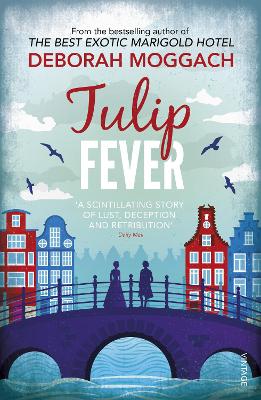
Tulip Fever
As seen:
By Deborah Moggach
avg rating
1 review
‘A gorgeous novel’ Mail on Sunday
From the bestselling author of The Best Exotic Marigold Hotel comes a thrilling story of power, lust and deception…
Seventeenth-century Amsterdam – a city in the grip of tulip fever.
Sophia’s husband Cornelis is one of the lucky ones grown rich from this exotic new flower. To celebrate, he commissions a talented young artist to paint him with his beautiful bride. But as the portrait grows, so does the passion between Sophia and the painter; and ambitions, desires and dreams breed an intricate deception and a reckless gamble.
Now a major film starring Oscar winners Dame Judi Dench, Alicia Vikander and Christoph Waltz and adapted for the screen by Sir Tom Stoppard.
TweetReviews
St Just Thursday Evening Reading Group 7th August 2025.
Tulip Fever. Deborah Moggach.
This book was generally liked by almost all of the reading group. Perhaps a slow start, some thought, but after that several people said they had found it fascinating, and one ‘devoured it in an afternoon’. Another commented that she ‘just loved the eating of the tulip – anti-capitalist and greed at its finest’. The characters became ever more interesting as the story progressed, we thought, particularly Cornelis, who started off portrayed as pompous and boring, but later was seen as someone with deeper feelings and intelligence.
There was a suggestion that the story was slightly far-fetched, particularly the faked pregnancy and substituted baby scenario, and this strand of the narrative slightly recalled Jessie Burton’s The Miniaturist, just as the matter of Willem mistaking Sophia for Maria because the mistress was dressed in the maid’s clothes recalls Much Ado About Nothing, and Sophia’s faked death Romeo and Juliet. Sophia’s behaviour, in having an affair with Jan the painter, perhaps reflected her youth and desperation and the lack of choices for women at the time. Jan’s character, his impulsive gambling and lack of household management, neglect of his apprentice and bad choice of servant, might have contributed to his downfall. Cornelis’s eventual fate was discussed, and what he might have done if he ever arrived in Batavia. The servants, Willem and Maria, some readers thought somewhat predictably, had everything turn out right for them at the end. Everyone was interested in whether the nun in the final scene is really Sophia or not.
We discussed the ‘tulip fever’ economic phenomenon, and when and how people gamble and take risks with money. We talked about Amsterdam, those who had visited it saying that it is a beautiful city, built on wooden stilts. The paintings which are included in the book were admired, and the information about them and how they set the scenes (one reader would have liked to see more paintings of tulips). The cover, however, was not thought very appropriate for the book.
A very readable and interesting book, though not particularly about tulips: recommended for any lover of art, history, and lyrical story-telling!