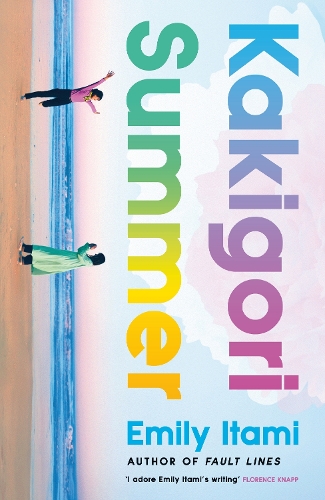
Kakigori Summer
As seen:
By Emily Itami
avg rating
3 reviews
‘I ADORE EMILY ITAMI’S WRITING’ FLORENCE KNAPP
Sisters Rei, Kiki and Ai have always had to look out for one another – but life has taken them on very different paths.
Eldest daughter Rei is spiky and sensible, distracting herself with an all-consuming job at a financial corporation in London.
Big-hearted Kiki is a single mother in Tokyo, juggling the demands of her young son and the cantankerous elderly residents of the retirement home she works in.
The free-spirited youngest, Ai , is a Japanese pop idol who has found fame and fortune but lost herself along the way. When Ai is embroiled in a scandal and thrust into the spotlight, Rei must pick up the pieces of her family once more.
Over the course of a summer in their childhood home on the Japanese coast, the sisters reunite with their sharp-tongued grandmother, entertain Kiki’s irrepressible son and silently worry about Ai, carefully avoiding the subject of their mother’s death fifteen years before. But silence between sisters can only last for so long . . .Transporting, funny and moving, Kakigori Summer is an uplifting exploration of love and loss, sisterhood and family, the stories we tell ourselves about the past and how they determine our future.
TweetReviews
This is likely to be one of my top five books for 2026. Having read a fair amount of Japanese fiction, this is one of the best that I have read. What sets it apart is that although the premise is simple, it is very well written and includes humour which can be unusual for Japanese fiction. The story focuses on three sisters that have come together after a crisis and follows their return to where they grew up. Various themes around family dynamics and how to find a place in the modern world are woven into the plot and it is thought provoking. Would highly recommend!
Rei, Kiki and Ai are three sisters, born to a Japanese mother and a British father and therefore known in Japanese as “hafu”, mixed race. While Rei is a high-flying business person in London, albeit somewhat disillusioned with her job, Kiki and Ai live in Japan. Kiki is a single mother and works in a care home for elderly people, Ai (the youngest) has become something of an idol in the music world. When Ai becomes involved in a scandal, the media are all over it. As both parents have died, the two older sisters know that they have to step in and rescue her. They all congregate in Japan for a summer of rest and recuperation in their childhood home next door to their domineering grandmother who insists on sharing her opinions at every available opportunity. This is the story of that summer.
I enjoyed this book and found it easy to read. The writing style is both casual and flows well. The narrative is told through the eyes of each of the three sisters, so we are privy to each of their private thoughts and musings as the summer wears on. This works well as the three sisters are all very different and one voice may not have done them justice. The characters are all well developed but for me, the starring roles have to go to the grandmother and Kiki’s 5-year old son, Hikaru, who are both very special indeed and add a lot to a book which is essentially very slow-paced.
I learnt an enormous amount about life in modern-day Japan, including information about day-to-day routines, traditions, culture, food, clothing, attitudes and so much more. For this I am very grateful indeed as it is a country I know very little about. The author herself is, I believe. “hafu”, which gives her a unique insight into the lives of the three girls and the way they are perceived by Japanese society as a whole.
When the girls start to reminisce about the past and discuss deeper issues towards the end of the summer there are some perceptive, insightful moments.
On the down side, the content of the book was neither challenging nor particularly interesting. By the very nature of the narrative it was slow-paced – the three girls are spending the summer trying to create a safe place in which Ai can recover. They quibble, bicker and fill their days with fairly mundane routines in an attempt to get Ai’s life back onto a normal footing. They also avoid tackling some of the major issues that have never been resolved from their upbringing. As they start to relax these issues do come to the forefront.
Whilst I both enjoyed this book and learnt a lot about Japanese culture, ultimately it was a little too slow for my liking. I prefer books to be either fast-paced and gripping or challenging and thought-provoking. Don’t let my opinion put you off reading it if you want a book with a good story which doesn’t require either brain power or adrenaline – ie a holiday read.
This author paints a vivid picture of emotional turmoil and grief, and life in a small village in Japan, as 3 sisters reconnect with each other over the course of a summer at their childhood home. The chapters jump from one sister’s perspective to another in quick succession, which for me was slightly jarring. It took me awhile to settle into the story, but I’m glad I did, as I enjoyed the second half of the book much more than the first.