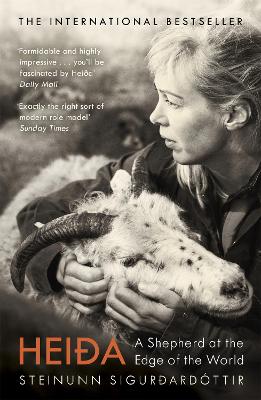
Heida: A Shepherd at the Edge of the World
As seen:
By Steinunn Sigurðardóttir
avg rating
5 reviews
‘HEIDA IS A FORCE OF NATURE . . . EXACTLY THE RIGHT SORT OF MODERN ROLE MODEL’ SUNDAY TIMES
The inspiring story of Icelandic sheep farmer, former model and feminist heroine Heida Asgeirsdottir has become a double prize-winning international bestseller.
As heard on Radio 4’s Start the Week
I’m not on my own because I’ve been sitting crying into a handkerchief or apron over a lack of interested men. I’ve been made every offer imaginable over the years. Men offer themselves, their sons . . . drunk fathers sometimes call me up and say things like: ""Do you need a farmhand?"" ""I can lift the hay bales"" ""I can repair your tractors"". . .
Heida is a solitary farmer with a flock of 500 sheep in a remorseless area bordering Iceland’s highlands. It’s known as the End of the World. One of her nearest neighbours is Iceland’s most notorious volcano, Katla, which has periodically driven away the inhabitants of Ljótarstaðir ever since people first started farming there in the twelfth century. This portrait of Heida written with wit and humour by one of Iceland’s most acclaimed novelists, Steinunn Sigurðardóttir, tells a heroic tale of a charismatic young woman, who walked away from a career as a model to take over the family farm at the age of 23.
I want to tell women they can do anything, and to show that sheep farming isn’t just a man’s game.
Divided into four seasons, Heida tells the story of a remarkable year, when Heida reluctantly went into politics to fight plans to raise a hydro-electric power station on her land. This book paints a unforgettable portrait of a remote life close to nature. Translated into six languages, Heida has won two non-fiction prizes and has become an international bestseller.
We humans are mortal; the land outlives us, new people come, new sheep, new birds and so on but the land with its rivers and lakes and resources, remains.
‘UTTERLY CHARMING’ MAIL ON SUNDAY
‘REVELATORY AND INSPIRING’ HERALD
TweetReviews
I really struggled with this book. Perhaps due to its translation, the language was clunky, and there was no flow. It was not at all reader friendly. There were quite a few grammatical errors, which will need to be corrected before publishing. I found myself speed reading big chunks of the novel. This is a shame, as the author clearly has a story worth telling, and worth telling well.
This is a gentle read. I was fascinated by the life of a female sheep farmer in the isolated wild lands of Iceland. Heida is an unusual woman. She lives a hard and lonely life, is driven, faces problems head on and manages a herd of 800 sheep in an isolated valley. Her thinking is deep and she is conscious of her responsibility both to her family farm and its lands and to the environment. She is a poet.
This book has short chapters and is a diary of one year in Heida’s life. Is has been translated from Icelandic and, although understandable, is quite a disjointed read. I would anticipate the final version being better and more polished than the proof copy I was given to review.
Heida owns a sheep farm in a remote hilly area of Iceland, close to one of Iceland’s active volcanos. She took over the farm at the age of 23 and has been running it on her own since then. When her land is threatened with the construction of a hydroelectric power plant, Heida has to enter the world of politics in order to fight her corner. This book spans a year in Heida’s life as she struggles to keep the farm up and running while she goes into battle with the power company.
This book gives an insight into the world of a shepherd in a remote location – and a very tough job it is too. It is not only physically demanding, there are multiple challenges encountered on a daily basis which all have to be fitted into an already busy schedule. Heida is also a poet and the book incorporates some of her work. I would imagine that translating poetry into a different language presents its own set of challenges and I think the translator did a particularly good job of this aspect of the book.
However, unfortunately my views were not all positive. Although the subject matter of the book really appealed to me, I thought the execution was poor in many areas. Firstly, it is written in a strange format – part diary, part memoir. Dated diary entries are interspersed with short chapters on various topics and then somewhat random poetry is thrown into the mix. This gives the whole book a very disjointed feel to it and makes it very confusing to read. I often struggled to work out where Heida was, the order of events leading up to that point and generally found it difficult to form a coherent picture of what was happening. I would have appreciated more information, more structure and more depth rather than the snippets which I was given. In addition, the sentence construction and grammar is, at times, decidedly peculiar – words in the wrong order and words used wrongly, often creating ambiguity. I don’t know whether it is the way the author has written the book or whether it is the translation process that has caused these issues. Whilst I am loathe to be overly critical of either as I know they have both done a better job than I could possibly have done, that doesn’t get away from the fact that the novel is muddled and therefore difficult to read. My final comment is that there is a lot of repetition within the book, which may be a result of the somewhat disorganised choice of writing style.
I did not find this book particularly enjoyable to read and would probably not go out of my way to read more by this author.
An interesting enough narrative about the author's life in Iceland.Her life is tough but rewarding with her commitment to the land that she farms.
Written over the four season of the year, Heida tells the story of her life as a sheep farmer in Iceland. The writing style is unique. It is simple, direct writing, which can also be a little jarring - perhaps the result of translating the story into English.
There are several themes throughout the book, including how women can do anything a man can do, children are not essential for a happy life, and how we have a moral and environmental obligation to the land we live on. Her story is interspersed with poetry slams and humour.
Heida writes knowledgeably from her perspective about the science of sheep farming. She is an expert sheep shearer and a professional sheep-pregnancy scanner, an essential service for sheep farmers throughout Iceland.
She writes about the business of farming, but also reveals a personal side of her life - how she battles sexism, depression, and the death of her older sister and father. She takes a no-go stance on the development of an unsightly power station planned for her area, despite some of her farming neighbours supporting the project.
Heida is a fanatical quad bike rider and a snowmobile enthusiast. She is a former model, teacher and policewoman as well as being a solo sheep farmer.
This is a very different story and while it took me some time to adjust to Heida’s writing style, in the end I enjoyed reading this book very much.