
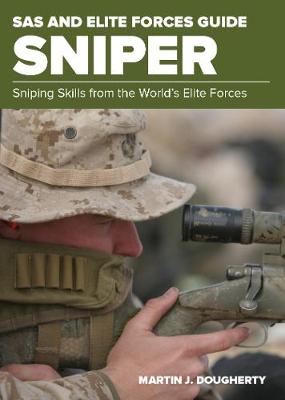
SAS and Elite Forces Guide Sniper: Sniping Skills From The World's Elite Forces
As seen:
By Martin Dougherty
avg rating
1 review
SAS and Elite Forces Guide: Sniper describes the psychological makeup of a sniper, what training is required to become an expert marksman, and what weapons are used by special forces snipers today. Using 300 instructive illustrations, Elite Forces Handbook: Sniper shows how special forces units such as the SAS, Army Rangers, Navy SEALs, and Delta Force train their most elite soldiers.
TweetReviews
It is a good book for those who are enthusiast but it doesn’t have every technique as what snipers need to become. They do provide basic field craft, Concealment and substantial amount of theory. They do have strong amount of understanding about the factors they may need to encounter. They also teach the history of the sniper weapon. It helps you to have strong substantial understanding in how the sniper man would need to carry out.
There are some sub heading that are worth to read through like
Sniper Hide
Concealment lies at the heart of sniping technique. Whether using an elaborate hide or taking advantage of naturally occurring concealment, the sniper remains unseen while he observes the enemy and sets up his shot. Those are one of my experiences when I was ambushing my enemy across the fields and observing their action, where they are placed at.
Taking accounts of factors that could take places like
Environmental factors e.g. wind and humidity.
Being patient waiting for the right moment and dedicated enough to make the shot without hesitation when the time comes. Must be able to hit the target.
Target Acquisition
Sniper will get one clear shot at an infantry before the survivors take cover. He must select the target that will cause the greatest effect, which will usually be the squad leader. A sniper who is well versed in standard infantry doctrine will know which of these soldiers is in command.
Potentially causing the whole morale to be devastated by the sniper shot.
A sniper is trained to select a target whose loss will have a greater effect on the enemy than that of a single infantry soldier. Officers, communications personnel and heavy weapons crews are all high-value targets: their loss degrades the enemy’s performance significantly. Eliminating a leader, or depriving him of the ability to give orders, can throw a force into confusion and prevent it from calling in support from aircraft or artillery.
Mentioning what types of rifles there are like
12.7mm (0.5in) bolt-action rifle, the Model 500 (RAI Model 500) is in service with the US Navy and Marines.
Steyr HS .50 has a heavy muzzle brake to reduce the recoil generated by its powerful 12.7mm (0.5in) calibre round.
Higher-level personnel, such as senior commanders or important specialists, are not usually found close to the combat area. A sniper may be able to infiltrate into an area where a conventional force would be quickly detected, and thus has the potential to eliminate key enemy personnel. The loss of a popular commander can demoralize enemy personnel; killing an efficient officer can weaken the whole force.
Snipers can also destroy enemy equipment. Anti-material sniping can be used to deprive the enemy of communications or radar equipment, or light vehicles, and weapons can also be targeted. A machine gun whose gunner is disabled can be used by another soldier, but one that is damaged by an armour-piercing round striking the receiver is inoperable in anyone’s hands.
Counter-sniping
Counter-sniper work is one of the most important tasks undertaken by snipers. Often this means passing up other targets in order to remain concealed. Eliminating a skilled enemy sniper is worth letting most other potential
Then it explains the history of the weapons only if you’re interested to learn what types of weapon they use to have.
All in all it is helpful and interesting to read it. I would personally read it twice to understand and practically find other information how the snipers practice shooting and how to use the knowledge in practice.